Un Study Women Equalty Effects on Family Household Income
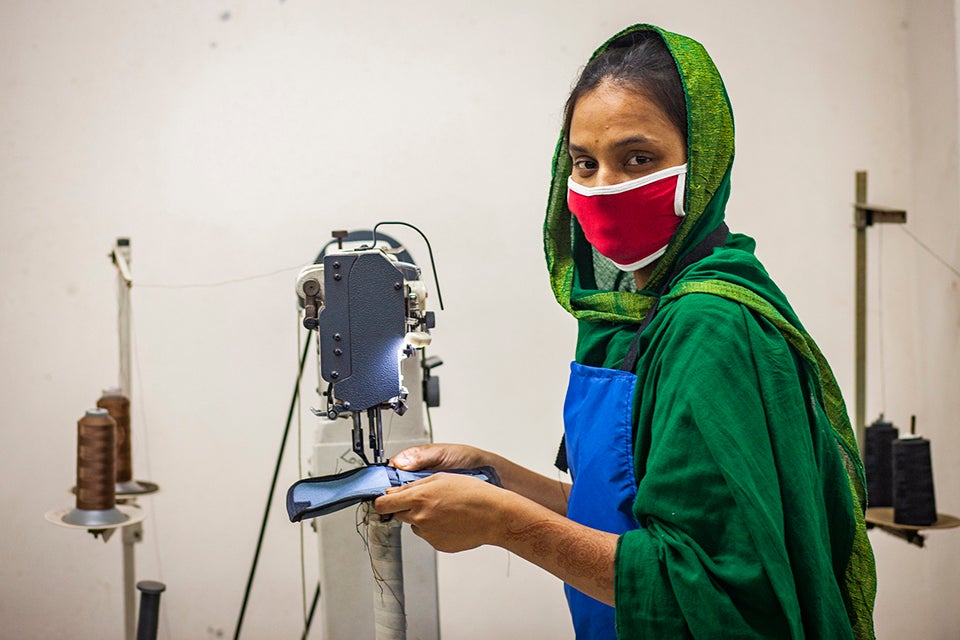
Riya Akter, 22, is an apparel worker. Asked if she was afraid of becoming infected with COVID-xix, she said work came showtime and needed to be done, otherwise there would not exist food on the table. She works while maintaining social distance with other workers as ready made garment (RMG) factories reopened amid the Covid-xix pandemic in Dhaka, Bangladesh. May 2020. Photo: UN Women/Fahad Abdullah Kaizer
The impacts of crises are never gender-neutral, and COVID-19 is no exception.
At a glance
Economic crises hit women harder. Here's why:
- Women tend to earn less.
- Women have fewer savings.
- Women are disproportionately more in the informal economic system.
- Women have less access to social protections.
- Women are more probable to be burdened with unpaid care and domestic work, and therefore have to drop out of the labour force
- Women make upwards the majority of single-parent households.
Larn more►
For the single mother in South Sudan, COVID-19 lockdown measures accept paused her small concern that brings nutrient to the tabular array.
For the domestic worker in Republic of guatemala, the pandemic has meant no job and no unemployment benefits or other protection.
For endless women in economies of every size, along with losing income, unpaid intendance and domestic work brunt has exploded.
While everyone is facing unprecedented challenges, women are bearing the burden of the economic and social fallout of COVID-19.
Women who are poor and marginalized confront an even higher risk of COVID-xix manual and fatalities, loss of livelihood, and increased violence. Globally, 70 per cent of health workers and showtime responders are women, and nevertheless, they are non at par with their male person counterparts. At 28 per cent, the gender pay gap in the wellness sector is college than the overall gender pay gap (16 per cent).
Here's how COVID-19 is rolling back on women's economic gains of past decades, unless we act now, and act deliberately.
The future of the poverty gender gap
"For the last 22 years, extreme poverty globally had been failing. Then came COVID-19, and with it, massive job losses, shrinking of economies and loss of livelihoods, especially for women. Weakened social protection systems have left many of the poorest in society unprotected, with no safeguards to conditions the storm," says Ginette Azcona, atomic number 82 author of United nations Women's latest report From Insights to Activeness and UN Women's Senior Research and Data Specialist.
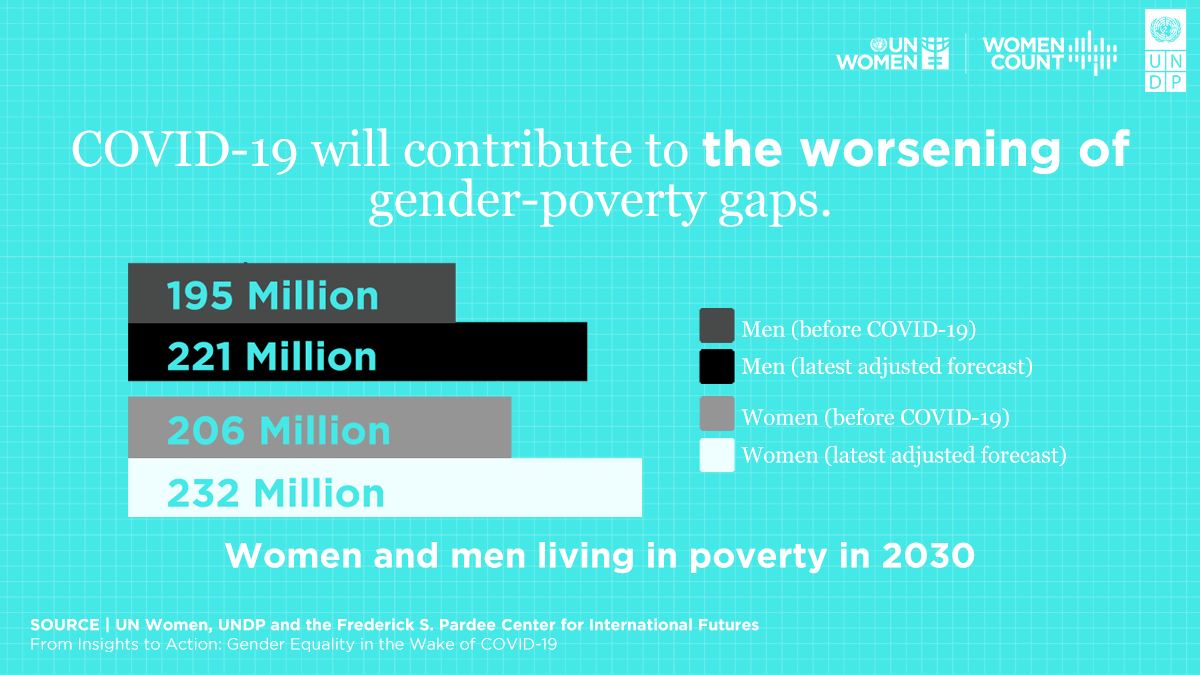
The recently released study shows that the pandemic will push 96 million people into extreme poverty by 2021, 47 million of whom are women and girls. This will bring the total number of women and girls living on USD 1.90 or less, to 435 million.
The pandemic-induced poverty surge will too widen the gender poverty gap – meaning, more women will be pushed into farthermost poverty than men. This is especially the case among those aged 25 to 34, at the height of their productive and family unit formation period. In 2021, information technology is expected there volition be 118 women aged 25 to 34 in extreme poverty for every 100 men aged 25 to 34 in farthermost poverty globally, and this ratio could rise to 121 poor women for every 100 poor men by 2030.
The resurgence of extreme poverty as a result of the pandemic has revealed women'due south precarious economical security," adds Antra Bhatt, Statistics Specialist and co-writer of the report From Insights to Action. "Women typically earn less and hold less secure jobs than men. With plummeting economical activity, women are particularly vulnerable to layoffs and loss of livelihoods."
Women's paid labour and women-run businesses will be hit difficult(est)
Women are losing their jobs. The pandemic and measures to prevent its spread are driving a disproportionate increase in women'southward unemployment (equally compared to men) and also decreasing their overall working time.
In South Sudan, Margaret Raman, a single mother of 5 who sells beans and groundnuts at a local market, lost more than 50 per cent of her income as social distancing guidelines drastically reduced the number of people visiting the market.
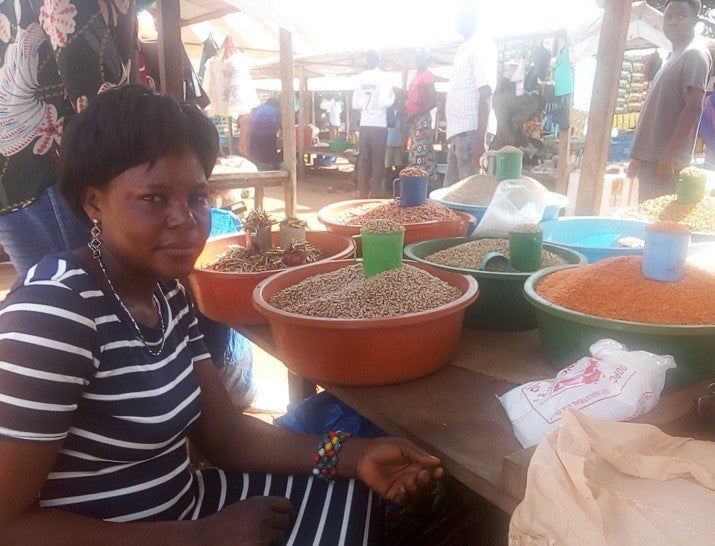
Margaret Raman selling beans and groundroots, before COVID-19 slowed her business to a stall. Photo: CAO/Alison Hassen
"Our businesses have been growing, only to be disrupted past COVID-xix," she said. "Since COVID-19, our lives accept non been the same. Nether normal circumstances, I make about SSP 28,000 [USD 100] in a week. This has recently been reduced to below half, SSP x,000 [USD 34] a week."
Raman'due south story is playing out in other parts of the world also. Since the get-go of the pandemic, in Europe and Key Asia, 25 per cent of self-employed women have lost their jobs, compared to 21 per cent of men –– a trend that is expected to go along as unemployment rises. Projections from the International Labour Organization suggest the equivalent of 140 million total-fourth dimension jobs may be lost due to COVID-19; and women's employment is nineteen per cent more than at risk than men.
These women are the faces behind the headlines, the people most affected past the economical touch of COVID-19 Unless, policies intentionally enable economic relief measures and deliberately target women, support women-led businesses and their income security, their situation will only worsen.
The most impacted industries have more women
Women are overrepresented in many of the industries hardest hit by COVID-19, such as food service, retail and entertainment. For case, 40 per cent of all employed women – 510 million women globally – work in hard-hitting sectors, compared to 36.6 per cent of employed men.
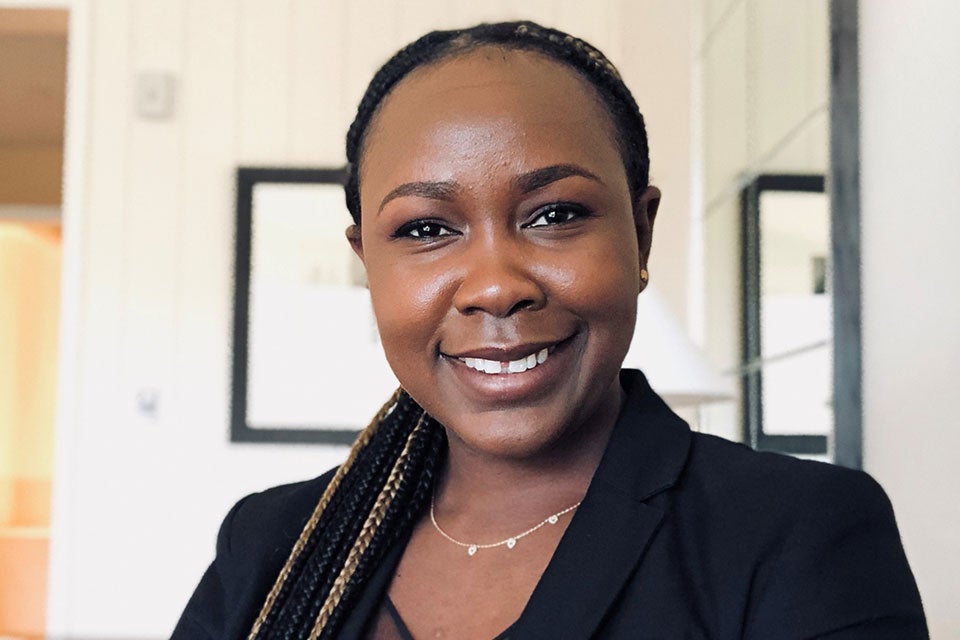
Ryancia Henry who works in the hospitality industry in the United States. Photo courtesy of Ryancia Henry.
"The financial affect on hospitality lonely has just been so staggering," said Ryancia Henry, a 32-year-old Caribbean area national working in the hospitality industry in the United States of America. "I worry for myself depending on how long this goes on, what kind of decisions do I have to make, to be financially okay, and I have the same concerns for my squad. I transport some funds home, to help my mom. I worry nearly maintaining some payments."
Inside some of these sectors where informal employment is common, workers were already subject to depression pay, poor working atmospheric condition and lacking social protection ( pension, healthcare, unemployment insurance) before the pandemic.
Globally, 58 per cent of employed women work in informal employment, and estimates suggest that during the first month of the pandemic, breezy workers globally lost an boilerplate of 60 per cent of their income.
When everyone stayed home, they sent the domestic workers packing
For domestic workers, 80 per cent of whom are women, the state of affairs has been dire: around the world, a staggering 72 per cent of domestic workers take lost their jobs. Even before the pandemic, paid domestic work, like many other informal economic system jobs, lacked bones worker protections like paid get out, notice menses or severance pay.
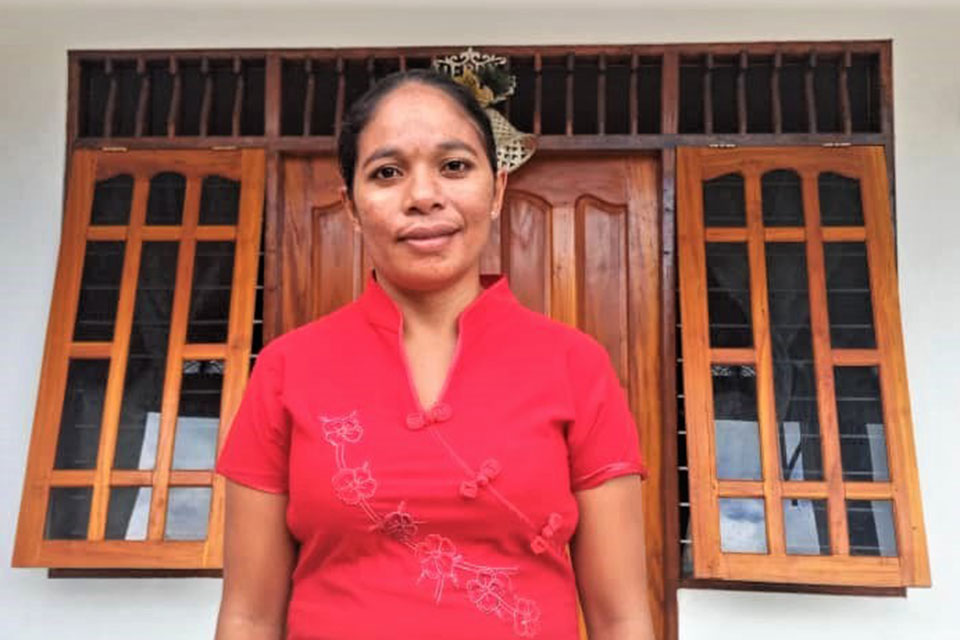
Ana Paula Soares stands in forepart of her family's firm in Ermera, Timor-Leste. Photograph courtesy of Natercia Saldanha
When the COVID-19 crunch came to Timor-Leste, Ana Paula Soares, a 27-twelvemonth-old who has been her family'due south breadwinner since 2017, lost her income and was left with no way to support her family.
Her story is the same as millions of women workers in the breezy economy.
"It'southward hard to make money at this time. People who work at the office, they continue to piece of work from abode and earn their salary regularly; but domestic workers cannot. Domestic workers should also be entitled to a bacon during times of crisis," said Soares. "Some didn't fifty-fifty receive their salary when they were asked to stop in the middle of the calendar month. I wish all employers would care for their employees equally."
In the absence of help from employers, domestic workers in Latin America accept been organizing their own networks of aid. Workers associations and unions are playing a critical role: "Their response has been truly admirable," said Adriana Paz, coordinator for Latin America at the International Domestic Workers Federation. "They have raised funds, door to door, at the local level and with political authorities. They accept organized community kitchens [and] have brought food to their affiliates' plates."
"Domestic workers' associations and unions are among the few organizations that have brought relief to the poorest neighbourhoods," added Paz.
Inequality at home and unpaid intendance
Every bit quarantine measures continue people at home, close schools and day-care facilities, the brunt of unpaid care and domestic piece of work has exploded. Both for women and men. Simply even earlier COVID-19, women spent an average of 4.ane hours per day performing unpaid work, while men spent 1.7 hours – that means women did three times more unpaid care work than men, worldwide. Both men and women study an increase in unpaid work since the start of the pandemic, only women are continuing to shoulder the bulk of that piece of work.
School and daycare closures, forth with the reduced availability of outside help, have led to months of additional work for women. For working mothers, this has meant balancing full-time employment with childcare and schooling responsibilities.
The responsibility of caring for sick and elderly family unit members ofttimes falls on women besides.
In Serbia, a phone call-in counselling centre run by the not-profit arrangement Amity, offers support to those who are alone or overwhelmed with intendance and housework during the lockdown.
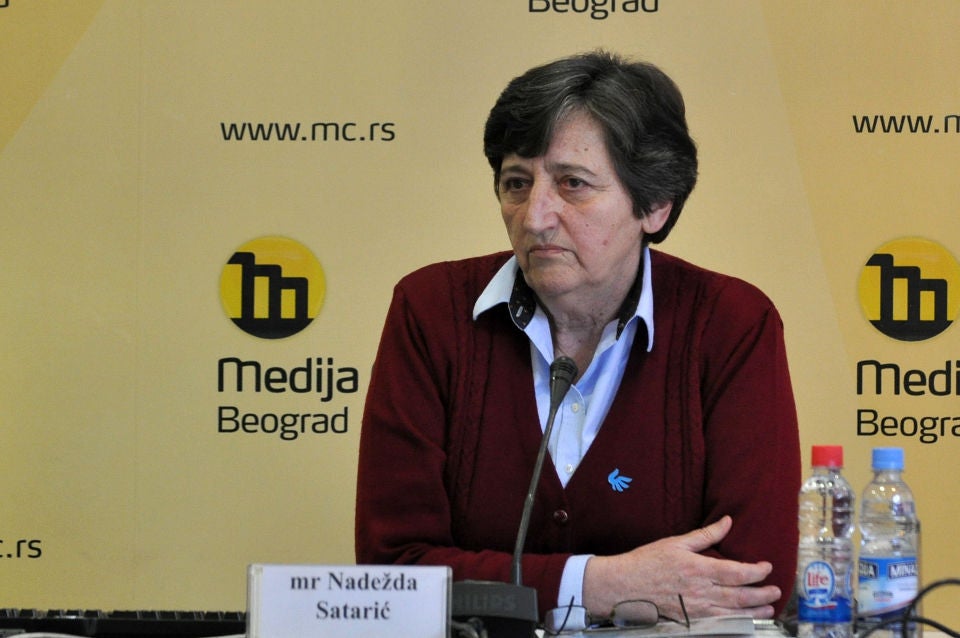
Cipher Sataric, founder of Amity NGO. Photo courtesy of Amity NGO.
"Most of the calls we become are from either older or younger women who intendance for their older relatives and family members, who found themselves in an countless bicycle of cooking, cleaning and intendance at dwelling during the lockdown," said Nada Sataric, founder of Amity. "Now is the time to acknowledge this unpaid care work and redistribute this burden."
Poverty and gaps in basic services and infrastructure add to women's unpaid workload. Globally, around 4 billion people lack access to safely managed sanitation facilities, and roughly three billion lack clean water and soap at home. In these situations, women and girls are the ones tasked with water collection and other tasks necessary for twenty-four hours-to-day survival.
The consequences volition outlast the pandemic
What nosotros know from previous crises
- In general, increased unemployment tends to encourage people to go back to traditional gender roles: unemployed men are favored more than heavily in the hiring process when jobs are scarce, while unemployed women take on more than household and intendance piece of work.
- During the 2008 economical crisis, the diversion of authorities funds toward relief efforts culminated in major cuts to social services and benefits, with heavy impacts on women.
- During the recent Ebola outbreak, quarantines significantly reduced women'due south economical action, driving a spike in poverty and food insecurity. While men'due south economic activity rebounded quickly, women's did not.
Acquire more►
Economic insecurity is not but jobs, and income loss today. It has a snowball effect on the lives of women and girls for years to come. Impacts on instruction and employment accept long lasting consequences that, if unaddressed, volition opposite hard-won gains in gender equality.
Estimates show that an boosted 11 million girls may leave schoolhouse past the end of the COVID crisis; evidence from previous crises suggests that many volition non render.
A widening education gender gap has serious implications for women, including a meaning reduction in what they earn and how, l and an increment in teen pregnancy and child marriage.
Lack of didactics and economic insecurity also increase the risk of gender-based violence. Without sufficient economic resource, women are unable to escape abusive partners and face a greater threat of sexual exploitation and trafficking.
These consequences won't disappear when the pandemic subsides: women are probable to feel long-term setbacks in work force participation and income. Impacts on pensions and savings volition have implications for women'due south economic security far down the road.
The fallout volition be almost severe for the about vulnerable women among us, those who are rarely in the headlines: migrant workers, refugees, marginalized racial and ethnic groups, unmarried-parent households, youth and the world's poorest. Those who accept recently escaped extreme poverty will likely fall back into information technology.
Recovery efforts must accomplish women
"Despite the clear gendered implications of crises, response and recovery efforts tend to ignore the needs of women and girls until it'due south too late. We need to do better," urges UN Women's Main Statistician, Papa Seck. "But most countries are either not collecting or not making bachelor data cleaved down by sex, age and other characteristics – such as class, race, location, disability and migrant status. These acute data gaps make it extremely hard to predict the pandemic's full impact in countries and communities. They also raise the concern that COVID-xix policy response will ignore the priorities of the nearly vulnerable women and girls."
Here are 5 steps that governments and businesses can take to mitigate the negative economic impacts of COVID-xix on women.
- Directly income support to women
Introduce economical support packages, including straight cash-transfers, expanded unemployment benefits, tax breaks, and expanded family and child benefits for vulnerable women and their families. Direct cash-transfers, which would mean giving greenbacks straight to women who are poor or lack income, --can be a lifeline for those struggling to afford day-to-mean solar day necessities during this pandemic. These measures provide tangible aid that women demand right at present. - Support for women-owned and -led businesses
Businesses owned and led past women should receive specific grants and stimulus funding, as well as subsidized and land-backed loans. Tax burdens should be eased and where possible, governments should source food, personal protection equipment, and other essential supplies from women-led businesses. Economic relief should similarly target sectors and industries where women are a large proportion of workers. - Support for women workers
Implement gender-responsive social protection systems to back up income security for women. For case, expanded access to affordable and quality childcare services volition enable more women to be in the labour force. Bridging the gender pay gap is urgent, and information technology begins by enacting laws and policies that guarantee equal pay for work of equal value and stop undervaluing the piece of work done by women. - Support for informal workers
Provide social protection and benefits to informal workers. For informal workers left unemployed, cash transfers or unemployment compensation can help ease the fiscal burden, as can deferring or exempting taxes and social security payments for workers in the informal sector. - Reconciliation of paid and unpaid work
Provide all primary caregivers with paid leave and reduced or flexible working arrangements. Provide essential workers with childcare services. Unprecedented measures to address the economic fallout have already been taken, but insufficiently few measures have been directed at supporting families grappling with paid and unpaid work, including care needs. More than efforts are also needed to appoint citizens and workers in public campaigns that promote equitable distribution of care and domestic work betwixt men and women.
Related content
Source: https://www.unwomen.org/en/news/stories/2020/9/feature-covid-19-economic-impacts-on-women

Post a Comment for "Un Study Women Equalty Effects on Family Household Income"